You can buy a stock illustration in thirty seconds. What you cannot buy is a set of pictures that know your story: the same child on page 3 and page 27, the house you described, the dog with one ear up. That is what a book illustration service is for, and it is what we do.
If you are earlier than that and still working out how the job runs, the stages a children’s book goes through before it reaches a printer is the longer explanation.
We are a three-illustrator studio in Lahore, working for self-publishing authors and small publishers in the US, Canada, the UK, Australia and Europe. Everything is drawn by hand. Nothing here is generated.
If you have a manuscript and are deciding who draws it, you can see what hiring us involves: what you get, what it costs to find out, and who does the drawing.
What a book illustration service actually delivers
This is the part most pages leave vague, so here it is plainly. A full picture-book commission delivers:
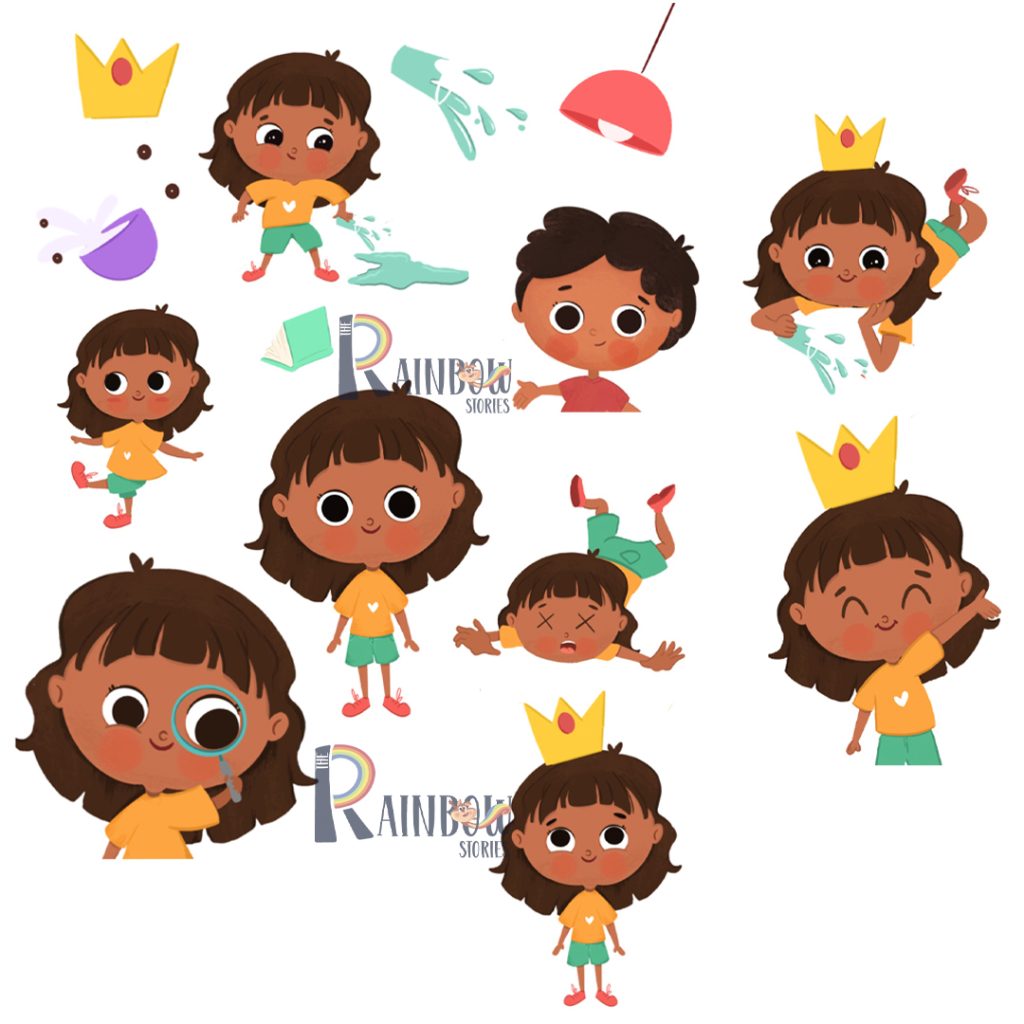
- Character sheets for every named character: front, side, back, and a range of expressions, so the character stays recognisably themselves across every page.
- A storyboard of the whole book at thumbnail size before anything is drawn properly, so pacing problems are caught while they are cheap.
- Finished interior artwork: full-page, double-page spread, or spot illustrations, in whatever mix the story needs.
- A cover as a full wrap: front, spine and back, with the spine width calculated from your page count and paper stock, plus a separate ebook cover.
- Print-ready files set up for Amazon KDP, IngramSpark, Barnes & Noble or EPUB, to each platform’s own specification.
How the work runs, start to finish
- You send the manuscript. We read it and come back with a quote and a date, usually within one business day.
- Characters first. Sheets for each character, with three to four rounds of refinement included at this stage. A character set takes about three business days.
- Then the storyboard. A 32-page storyboard takes about three weeks. This is the last point at which changing the structure of the book is free.
- Roughs, then colour. You see every page in rough before it is coloured. Nothing goes to final art without your sign-off.
- Print-ready files. Set up for your platform and checked against its specification before they are sent.
End to end, a full picture book is 10 to 14 weeks from accepted quote to print-ready files, including the time you spend reviewing. The exact timeline goes in your quote, because a 24-page book with two characters and a 40-page book with nine are not the same job.
What you own at the end
Full copyright transfers to you on final payment, including commercial use. The artwork is yours to print, sell, licence and reuse. We keep the right to show the work in our portfolio and nothing else.
If a platform rejects a delivered file on specifications, we fix it at no charge. That is not a goodwill gesture. A file that will not upload is not a finished file.
What moves the price
Every book is quoted individually and there is no price list on this site, for a reason: the same page count can be half the work or twice it. Three things move a quote more than anything else.
- How many characters. Each one needs its own sheet before it can appear on a page.
- How complex the backgrounds are. A character on white and a character in a crowded market street are different jobs.
- The mix of full spreads and spot illustrations. A book of 14 full spreads costs more than a book of 14 spot drawings, and both are legitimate choices.
Send the manuscript and you get a real number against your actual book, not a range that turns out not to apply.
Who we are a good fit for, and who we are not
We are a good fit if you have a finished or near-finished manuscript for children aged roughly 2 to 12, you want one illustrator on your book rather than a rotating pool, and you want the style to be warm and cartoonish rather than painterly or photoreal.
We are the wrong choice if you need artwork by Friday, if you want a price before anyone has read the manuscript, or if you are after a style we do not work in. In those cases a marketplace will serve you better and we will say so rather than take the job.
Why authors come to a studio rather than a marketplace
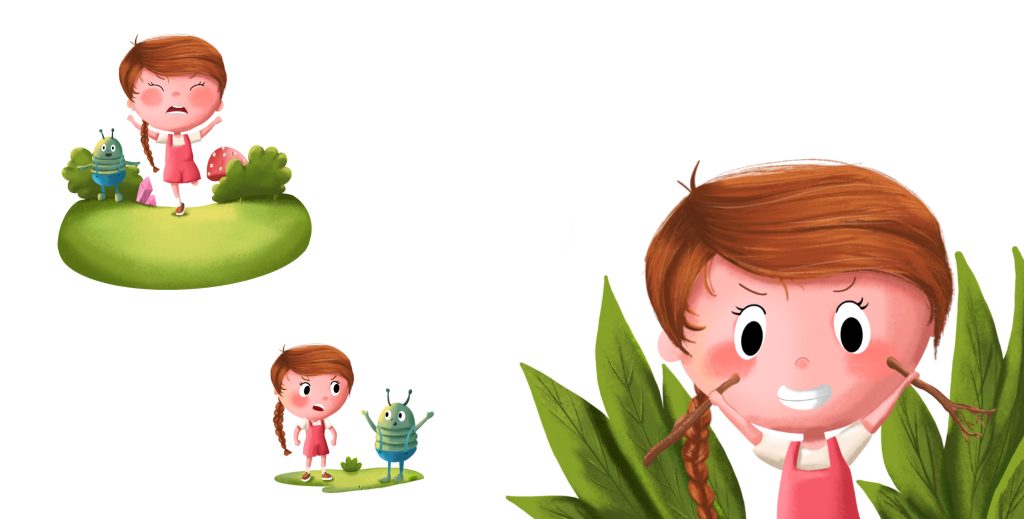
On a marketplace you are buying hours from whoever is available. The illustrator has not read your book, will not remember it next month, and has no stake in whether it sells. The practical result is usually visible on the page: a character who drifts, backgrounds that do not match, a cover that looks like it belongs to a different book.
Here, one illustrator takes your book from character sheets to print files. Four of us work in the studio: Amna Zaki, Amna Ashraf, Ayesha and Noor, and you are told which one has your book before you commit. Between us we have illustrated more than 100 children’s books over seven years; more than 50 of those are Amna’s own.
Is a book illustration service worth it?
It depends on what you are making, and the honest answer is that it is not always.
It is worth paying for when the book is going on sale. A picture book lives or dies on whether the same child looks like the same child on page 3 and page 27, and that consistency is the hardest thing to produce without a character sheet and someone who has read the whole manuscript. It is also worth it when you need print-ready files: a cover wrap whose spine width is calculated from your final page count and paper stock is not something you can fix later, and a printer rejecting your file three days before launch costs more than the illustration did.
It is not worth it when the book is a gift for one child, when it runs under about twelve pages, when you can draw and simply need the time, or, most often, when the manuscript is not finished. Paying for artwork against a story you are still rewriting means paying twice. Finish the words first.
The figure authors usually want: a full picture book is a four-figure commission, and what moves that number is page count, how many characters appear, and how detailed the scenes are. If that is beyond the budget for this book, illustrating a cover only is a legitimate halfway step.
How to judge an illustration service before you pay
Most portfolios are a highlights reel. A highlights reel tells you someone can draw one good picture, which was never the question. Five things worth asking:
- Ask to see one whole book, not twenty single images. The same character across several spreads from the same project is the only evidence of the skill that matters. If nobody will show you that, there is a reason.
- Ask who actually draws it. On marketplaces the person you message is often not the person who draws, and may not be the same person next month. Ask for a name before you commit.
- Ask what you own at the end, in writing. Full copyright transferring to you on final payment is the normal arrangement for commissioned book illustration. Anything less should be stated plainly, not buried.
- Ask about print files. The answer should include 300 dpi, CMYK, bleed and trim, and a cover wrap sized from your page count. Vague answers here turn into rejected uploads at KDP or IngramSpark.
- Ask whether any of it is generated. AI artwork is cheap, fast and increasingly hard to spot in a single image, but it fails on exactly the thing a picture book needs, which is the same character behaving the same way across thirty pages. Ask, and ask to see the roughs.
Rough drawings are the useful request in all of this. Finished art can be bought, borrowed or generated. Pencil roughs and character sheets are the working evidence that a human planned the book.
When to illustrate the book yourself
Plenty of authors should. If you can draw, if the book is short, if it is personal rather than commercial, or if the budget is better spent on editing, doing it yourself is the right call and nobody here will tell you otherwise.
What tends to catch self-illustrating authors out is not the drawing. It is keeping a character identical across twenty-four pages, and producing files a printer accepts. If you want to try it, the step-by-step version is here, and the canvas sizes to start from are here.
A middle route exists and is underused: commission the character sheets, then draw the rest yourself against them. You get the consistency and keep most of the budget.
Questions authors ask
Are book illustration services worth it?
For a book you intend to sell, yes, mainly for character consistency across spreads and for print-ready files. For a one-off gift, a very short book, or a manuscript still being rewritten, no.
Can I trust a book illustration service?
Judge it on three things: whether they will show you a complete book rather than single images, whether they will name the illustrator who draws yours, and whether copyright transfer and file specifications are stated in writing before you pay.
What is the difference between a studio and a marketplace?
On a marketplace you buy hours from whoever is available. In a studio one illustrator takes the book from character sheets to print files, and you are told which one before you commit.
How do I know artwork is not AI-generated?
Ask to see the pencil roughs and character sheets. Generated images rarely survive the test of the same character across thirty pages, and the working drawings behind a hand-drawn book cannot be produced after the fact.
Starting
Send the manuscript, say roughly how many pages you have in mind and when you need it. You get a quote and a date back, usually within one business day. There is no charge for the quote and no obligation after it.
Ask for a quote on your book: tell us about the manuscript and we will come back with a price and a timeline.
Ready to Bring Your Children's Book to Life?
Don't leave your story as just a draft. Led by an illustrator with more than fifty children’s books behind her, we handle character turnarounds, full-spread interior art, and print-ready publishing files for Amazon KDP, IngramSpark, EPUB and Barnes & Noble.
We do character design, storyboarding, book covers and complete books.