There are two different jobs hiding inside the phrase “character work”, and mixing them up costs authors time and money. Character development is what happens in your manuscript: who your character is, what they want, and how they are different by the last page. Character design is what happens on the page: the face, the proportions, the colour, the clothes, the expressions. One is writing. The other is drawing. You need the first before anyone can do the second well.
This post is about the first one, because it is the part that decides whether the second one goes smoothly.
A developed character is not a detailed character
You can tell an illustrator that your rabbit is grey with one torn ear and still have given us almost nothing to draw. A torn ear is not a personality. What we actually need is simpler to say and harder to answer: what does this character want, what is getting in the way, and what are they like when they do not get it?
Answer those three and the drawing almost designs itself. A rabbit who wants to be first through the gate stands differently from a rabbit who wants to be left alone. That difference is posture, eyeline, the set of the shoulders. It is not something an illustrator can invent for you without guessing.
Three things young readers attach to
1. A want they can say out loud
Children follow wanting better than they follow feeling. “She wants the last seat on the bus” works. “She struggles with belonging” does not, not yet. Keep the want small, concrete and visible, and the emotional weight comes along behind it on its own.
2. A flaw that is not cute
Clumsiness and forgetfulness are not flaws, they are decorations. A real flaw costs the character something: she interrupts, he takes the biggest piece, she tells a small lie and then has to live inside it. Children recognise these instantly because they are working on the same problems. A character who has never done anything wrong is a character nobody needs to forgive, and forgiving is half of why we love anyone.
3. A change they can see
Growth that happens only in a character’s head cannot be illustrated, and for a young reader it did not happen. Find the moment where the change becomes an action: she gives up the seat, he hands over the biggest piece, she says the true thing out loud. That single page is usually the most important illustration in the whole book, and it is the one to brief most carefully.
Age changes what development can carry
Ages 2 to 5. One want, one obstacle, one resolution. The character does not need to change so much as complete something. Repetition is a feature, not a weakness, and the visual personality does most of the work.
Ages 6 to 8. Now a character can be wrong and find out. There is room for a flaw with consequences, a friend who is affected by it, and a change the reader can predict a page or two before it arrives. This is the sweet spot for the three things above.
Ages 9 to 12. Interior life opens up. A character can want one thing and need another, and can hide something from the reader. The illustration load shifts from showing the action to showing what is behind the face.
How this reaches the drawing
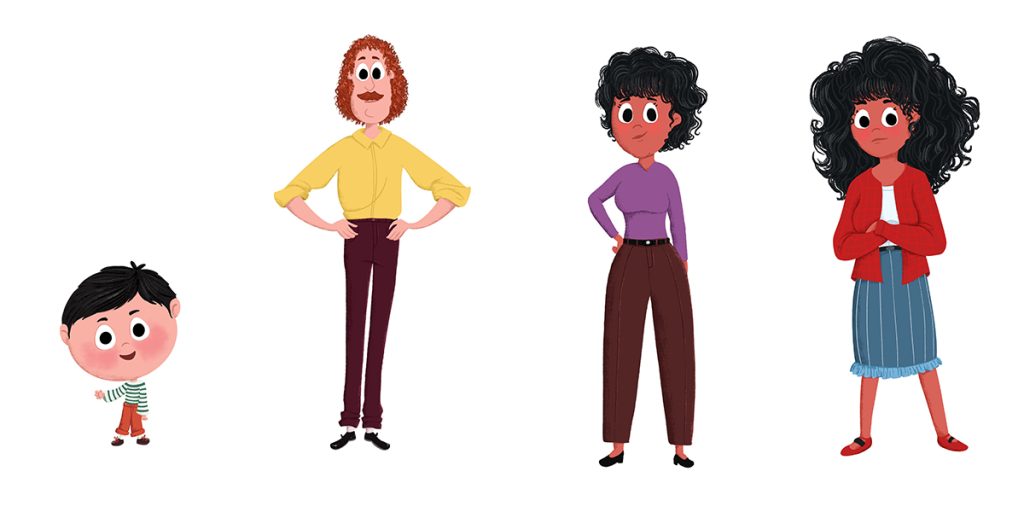
When a manuscript arrives with a developed character, the design work is faster, cheaper and better. We can build an expression sheet that covers the emotions your story actually calls for instead of a generic set of six. We can give the character a silhouette that matches their temperament. We can age them correctly for your reader, which is a surprisingly common thing to get wrong.
When it arrives without one, the first round of sketches becomes a guessing game, and revisions are where illustration budgets quietly disappear.
If you want to see what this looks like finished, our character design portfolio collects the casts we have drawn for published children’s books – every one of them drawn by hand, with no AI. You can also browse the full illustration portfolio by subject if you are looking for a particular kind of world.
Before you brief an illustrator
Write three sentences for each main character: what they want, what is in the way, and what they do differently at the end. Not a description, not a list of features. Three sentences. If you can write them, you are ready to have the character drawn. If you cannot, that is worth knowing before you pay for sketches.
When you are ready, send us the manuscript and we will tell you honestly what we think the character needs.
Ready to Bring Your Children's Book to Life?
Don't leave your story as just a draft. Our award-winning illustrators handle character turnarounds, full-spread interior art, and print-ready publishing files for Amazon KDP & IngramSpark.